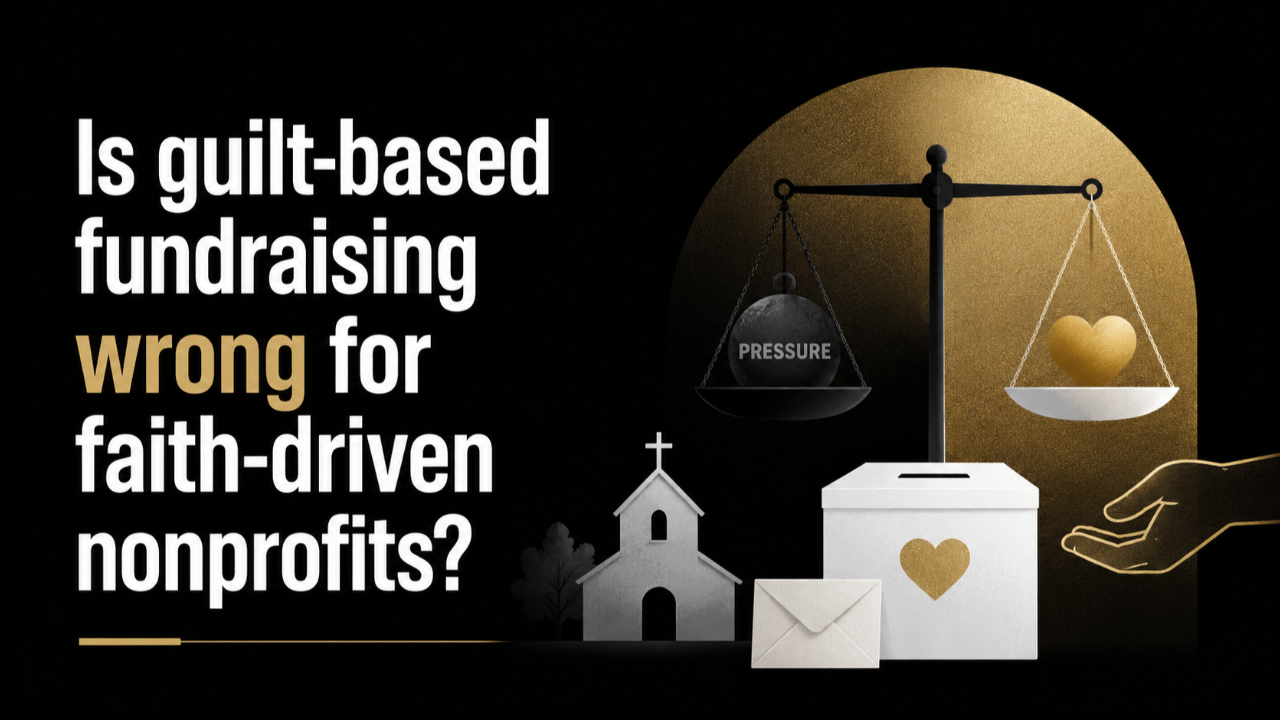
Is Guilt-Based Fundraising Wrong for Faith-Driven Nonprofits?
Jun 17, 2026There is a moment in many nonprofit website reviews where someone says, "We can't say that. It feels too dark."
They're usually pointing at a line that names what happens when a donor doesn't give, or when a community doesn't get the support it needs. The instinct to pull back is understandable.
Nobody wants to feel manipulative.
Nobody building a faith-driven organization wants to be accused of running a guilt campaign.
But pulling that line almost always makes the messaging weaker, and the people you're trying to reach less likely to act.
Here's the thing: failure stakes, done right, have nothing to do with guilt.
What failure stakes actually are
Donald Miller's StoryBrand framework builds on a simple observation about how stories work.
Every story has a hero who wants something.
Every hero faces a problem.
And every hero has something to lose if they don't solve it.
That last piece, what the hero stands to lose, is the failure stake.
In a film, it's obvious.
The village gets destroyed.
The relationship ends.
The business collapses.
The audience feels that weight, and it keeps them watching.
In your nonprofit messaging, the failure stake is just as real.
A family enters winter without stable housing.
A student drops out before graduating.
A congregation loses connection with younger members and can't understand why.
These are the actual outcomes your donors are helping prevent.
The problem is that most faith-driven nonprofits skip this part entirely.
They jump straight from "here's our mission" to "here's how you can give."
They leave out the middle section where the reader feels the weight of the problem and understands what hangs in the balance.
When you skip that step, you skip the reason people feel compelled to act.
The difference between honest tension and manipulation
Manipulation is manufactured. It exaggerates harm that isn't real, or implies the donor is personally responsible for suffering they had no hand in creating.
Guilt-based fundraising tells people they should feel bad if they don't give.
It makes the donor the villain of the story.
That's not what failure stakes are.
Honest tension tells a true story about a real outcome. It respects the reader enough to let them understand what's actually at stake.
It says: here is what the problem costs if left unsolved.
Now here is how you can be part of solving it.
The donor is the hero in that version.
They're being invited into a story where their action matters, not accused of causing harm through inaction.
One line.
That is usually all it takes.
Something like:
- "Without support, these families face another year without a plan."
- "When kids don't have a trusted adult in their corner, the statistics get hard to read."
- "Churches that can't reach people digitally are often the ones that close."
None of those are dark. None of them assign blame. They are simply honest about the gap between the current situation and the outcome your organization exists to prevent.
Why faith-driven leaders pull back from this and what it costs them
There is a theological instinct behind the reluctance. Many leaders in faith-driven organizations came up in communities that saw fear-based messaging and were rightly turned off by it. They watched organizations run campaigns that leaned on shame, and the damage was visible.
That experience is worth holding onto. But it can also cause leaders to overcorrect, stripping out any mention of consequences until their messaging reads like a press release. Warm, yes. Clear about what's at stake, no.
The cost is real:
Messaging without failure stakes tends to feel low-urgency.
Donors file it under "I'll get to this eventually."
The ask doesn't land because the reader doesn't feel pulled toward a decision.
You just need to tell your audience the truth about what your work addresses and what happens when that work doesn't reach the people who need it. You are simply setting up respect for the problem you're trying to solve.
How to write failure stakes that actually work
3 practical filters help here.
The first is proportionality. Match the weight of the stake to the actual severity of the problem. A food bank can say that families go without meals. A leadership training nonprofit doesn't need to suggest civilization collapses without their coaching program. Keep it true to the scale of what you actually do.
The second is specificity. Vague stakes don't move people. "The need is great" means nothing. "Without this program, 300 students lose their after-school placement in March" means something. The more specific the picture, the more a reader can actually feel it.
The third is speed. State the failure stake, let it land for a sentence or two, then move to the success vision. You are not trying to make people feel terrible. You are giving them a moment to feel the weight of the problem so that the hope you're offering feels earned. Stay in the dark too long and it tips into manipulation. Move through it honestly and it becomes motivation.
A simple structure that works:
- State the external problem (what the situation looks like on the surface).
- Name what it costs the people you serve (the real, human impact).
- Show the path forward (where your organization comes in).
- Cast the success vision (what a donor's action makes possible).
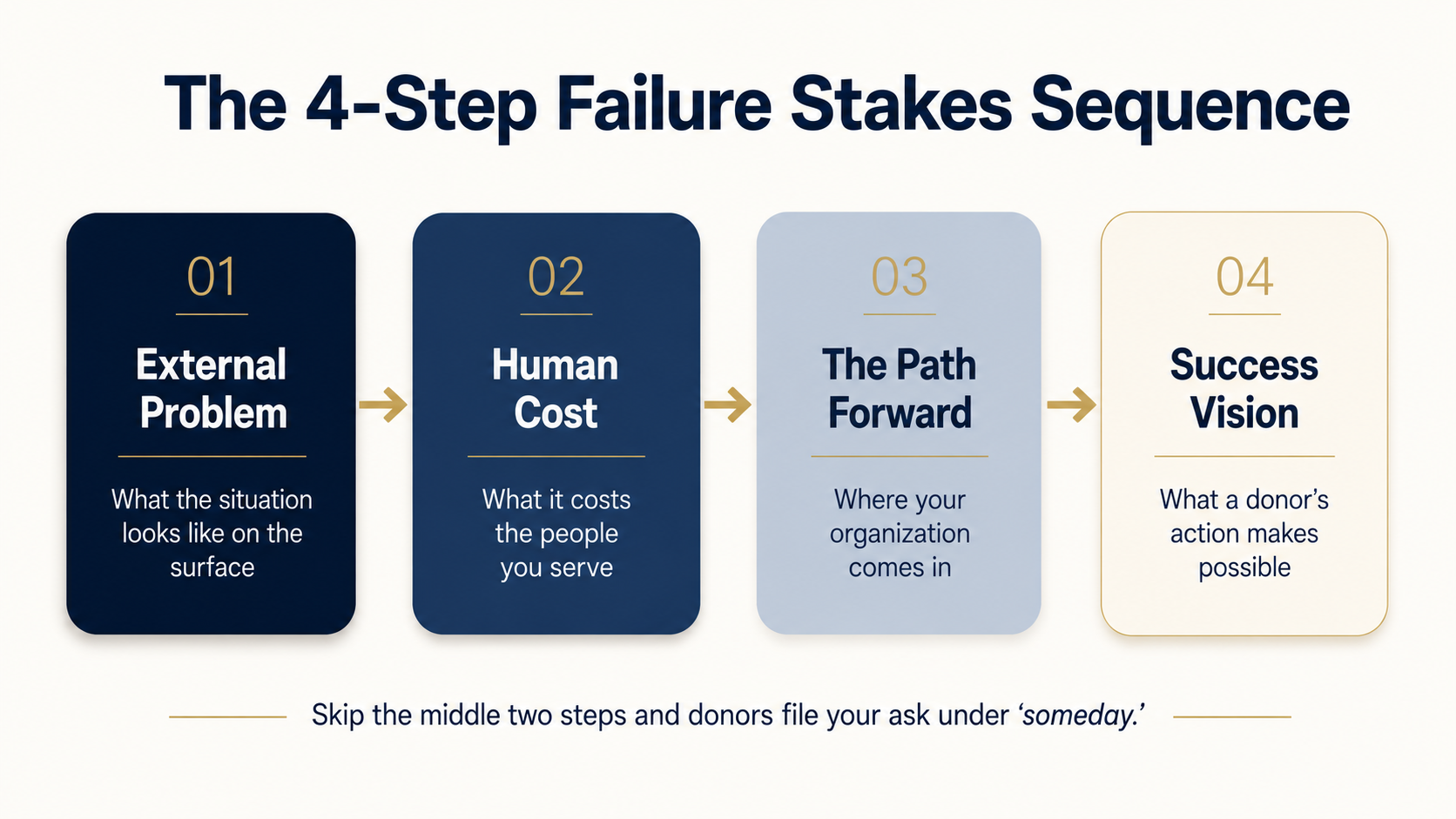
That sequence works for websites, fundraising emails, grant narratives, and donor stewardship letters. All this requires is a willingness to not skip the middle.
The version of this that honors your mission
If you lead a faith-driven organization, you believe the work you do matters. You believe the people you serve matter. You believe the problems you're addressing are real and worth fighting.
Failure stakes are just that belief put into words. They are the honest acknowledgment that things could go a different direction if your work doesn't happen. They give donors a reason to act now instead of someday.
"Someday" is where most donation decisions go to die.
The version of this that honors your mission is the one that tells the truth about what's at stake, invites donors into the story as the people who change the outcome, and then shows them exactly what that outcome looks like.
For cause-driven leaders, it is the most honest form of marketing you can do.