5 Steps Every Nonprofit and Ministry Leader Needs to Get Real Mileage Out of Every Media Mention
Jul 01, 2026You worked for months to earn a media mention. A reporter covered your work. A podcast invited you on. A denominational publication ran a story about your partnership. Your team celebrated for a day, posted a link on social media, dropped a line in the newsletter, and moved on.
That is the most common and most costly mistake leaders make with earned media. The opportunity cost is significant.
Most organizations extract about 10 percent of the value from any media placement they earn. The other 90 percent evaporates because there is no system for what happens next. This article is about building that system.
The Core Problem With How Organizations Handle Media Coverage
When coverage lands, the instinct is to share it. Leaders post the link, tell people to go read it, and call that activation. The problem is that every one of those actions routes your audience away from your properties and toward someone else's. You worked to earn that credibility from the outlet, then handed the traffic right back to them.
Earned media is raw material. The organizations that treat it that way turn a single placement into weeks of content and a growing audience on their own platforms. The ones that stop at the share link wonder why their authority never seems to grow despite regular coverage.
The PRESS Framework is the system for treating earned media as the starting point it actually is. It lives inside the Trust pillar of the A.R.T. of Engagement framework, built specifically for cause-driven organizations that want to convert every earned media moment into owned momentum.
What PRESS Stands For
PRESS is a five-step sequence that any organization can run on any piece of earned media, regardless of the outlet, the format, or the size of the placement. It works the same way whether you were featured in a national publication, quoted in a denominational newsletter, or appeared on a regional podcast.
Each step builds on the one before it.
P: Post It on Your Own Property First
Before you share anything anywhere, create a home for the coverage on your own site.
This is a blog post or media page entry written in your voice, with your context, and with a call to action that points somewhere useful for your audience. The goal is framing — telling your audience what this coverage means, what it says about the work you are doing, and why they should care.
The outlet's authority becomes a citation in your story. Your site gets the traffic.
Most organizations build a dedicated media page as part of this step, a single place where all placements live with outlet logos displayed prominently. That page does ongoing work. It sits on your website 365 days a year showing every new visitor that your organization has been trusted enough to be featured. It is proof that belongs to you.
R: Repurpose the Format
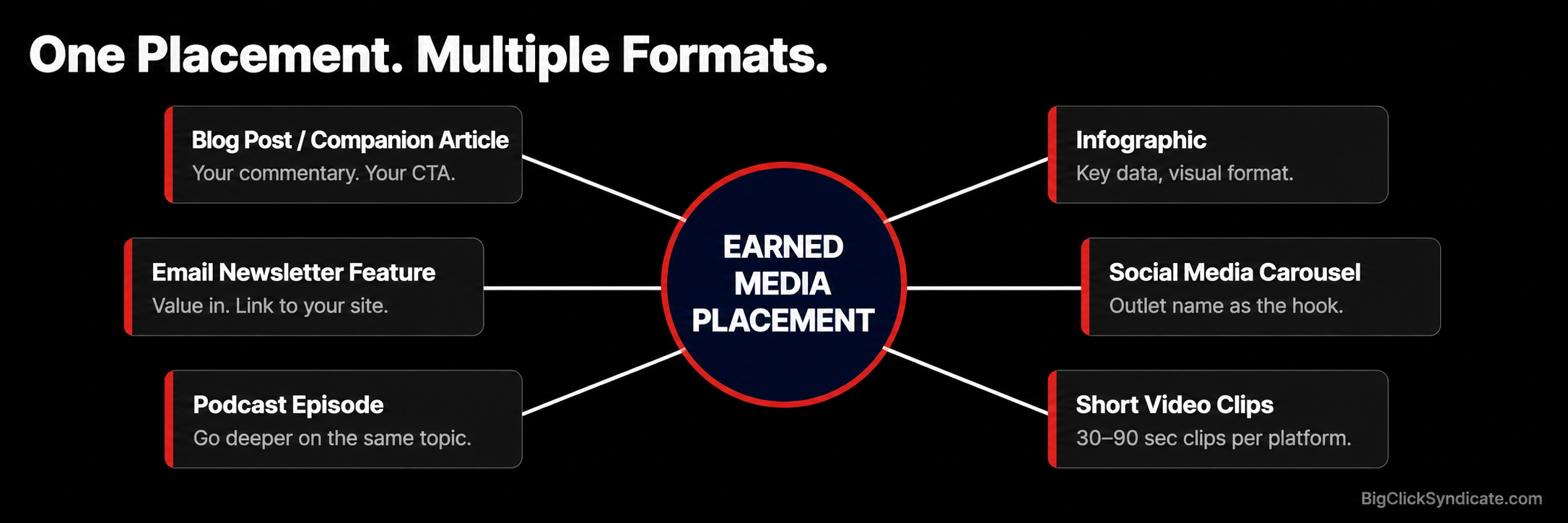
Every media placement arrives in one format, whether that is a written article, a podcast interview, or a video segment. Translating it into at least one other format means different audiences encounter the same message across different channels.
Pick one additional format per placement and produce it well. A written article becomes a five-minute podcast episode that goes deeper on the same topic. A podcast appearance becomes a written summary post that earns search traffic. A video interview gets clipped into two or three shorter segments for social. Any format can be distilled into an infographic.
The practical question is simple: who on your team can execute a format conversion this week, and which conversion will take the least effort while delivering the most value? Start there.
E: Email It the Right Way
Your email list is your highest-trust channel. The people on that list gave you direct permission to reach them. When coverage lands, that list should hear about it in a way that deepens the relationship with your organization.
The most common approach is a quick note with a link to the article, one or two lines followed by "Click here to read the full piece." That routes your most engaged audience off to a third-party site with no particular reason to come back.
A better approach brings the substance of the coverage into the email itself. Summarize what was covered. Share your perspective on it. Connect it to something your audience cares about. Then give them a call to action pointing to your companion post, your media page, or your next event. Your newsletter is where credibility transfers from the outlet to you, so keep people in that conversation long enough for the transfer to happen.
S: Slice and Distribute
This step works within the same format, moving content from one platform to another.
A full podcast episode becomes three audio clips, a video interview becomes five short-form videos, a written feature becomes a pull-quote image series for social, and a data-heavy article becomes a carousel post.
When distributing, lead with the outlet's name or the journalist's affiliation. That name is doing credibility work for you. A post that says "We sat down with [Publication Name] to discuss..." will outperform a generic post on the same topic every time because the audience recognizes the outlet and the trust transfers. The outlet earned that attention; you are borrowing it at the moment it matters most.
S: Secure the Next Placement
Existing coverage is the best tool for earning more coverage. Journalists and podcast hosts look for guests and sources who have already been vetted by someone they recognize. When you have a clip from a credible outlet, the pitch for the next outlet is straightforward.
Within a week of any significant placement going live, identify two or three adjacent publications, podcasts, or platforms serving a similar audience. Send a short note that leads with what you were just featured on. The note needs to be specific and establish that someone else already thought you were worth their audience's time.
Update every professional biography, speaker profile, and booking page at the same time. "As featured in" above your name is a signal that reduces friction for every future media relationship, and it costs nothing to maintain once it is in place.
Why Executive Leaders Should Care About This System
Every step in this framework is something a team member can own. The PRESS sequence is designed to become a standard operating procedure. When a placement goes live, the same set of actions happens in the same order, regardless of who is on the team or what kind of coverage it was.
That consistency means your media presence grows in a predictable, documented way rather than in sporadic bursts whenever someone remembers to follow up. Every dollar and hour your organization spends on communications work generates a return that extends well beyond the day the article publishes.
Over time, organizations that run this system build a growing archive of third-party credibility living on their own platform. Every new visitor who arrives finds a track record that most peer organizations never accumulate.
If you want help applying the PRESS Framework to your organization's earned media strategy, that conversation starts at artofengagement.org.