Your organization is doing important work. Nobody can explain what it is.
Mar 16, 2026There's a specific kind of meeting that happens inside almost every nonprofit and cause-driven organization. The executive director is in the room. So is the COO, the development director, maybe a program director or two. Someone asks a question that should have a clean, confident answer.
"So how do we actually describe what we do?"
What follows is a twenty-minute conversation that goes in five different directions. Everyone in the room is smart. Everyone is deeply committed to the mission. And every single person explains the organization's work slightly differently.
That is a strategy problem. And it is costing organizations more than most CEOs want to admit.
The gap nobody talks about
Most organizations have a mission statement. Most have a vision statement. Many have a set of values printed somewhere on a wall or a website.
What almost none of them have is a codified worldview. A structured, documented articulation of why they believe the problem they are solving persists, what must be true to actually solve it, and what breaks when any one of those beliefs is not acted on.
I call this a Conviction Map. And the absence of one is showing up in your organization in ways you may not be able to fully see from the inside.
What a Conviction Map actually is
A Conviction Map is the intellectual backbone behind your mission. It is the philosophy of your work made visible and portable. Every cause-driven organization carries this worldview somewhere. Usually it lives in the founder's gut, in the instincts of senior leadership, in the culture of the team. But it has never been pulled out of those heads, named, sequenced, stress-tested, and turned into something every person in the organization can point to and repeat.
The Conviction Map does that. It answers the question every donor, partner, staff member, and constituent is quietly asking: why does this organization exist, what do they actually believe, and why should I trust that their approach works?
When it is built well, it produces one more thing: a manifesto-worthy problem statement. A single declaration, earned through the full logic of the map, that captures what the organization is fighting for in language that is unforgettable and repeatable by anyone.
What breaks when it is missing
Think of concentric circles radiating out from the center of your organization. At the center is the founder or executive director. Then the executive team. Then managers. Then staff. Then volunteers. Then donors. Then major funders. Then community partners. Then the people you serve.
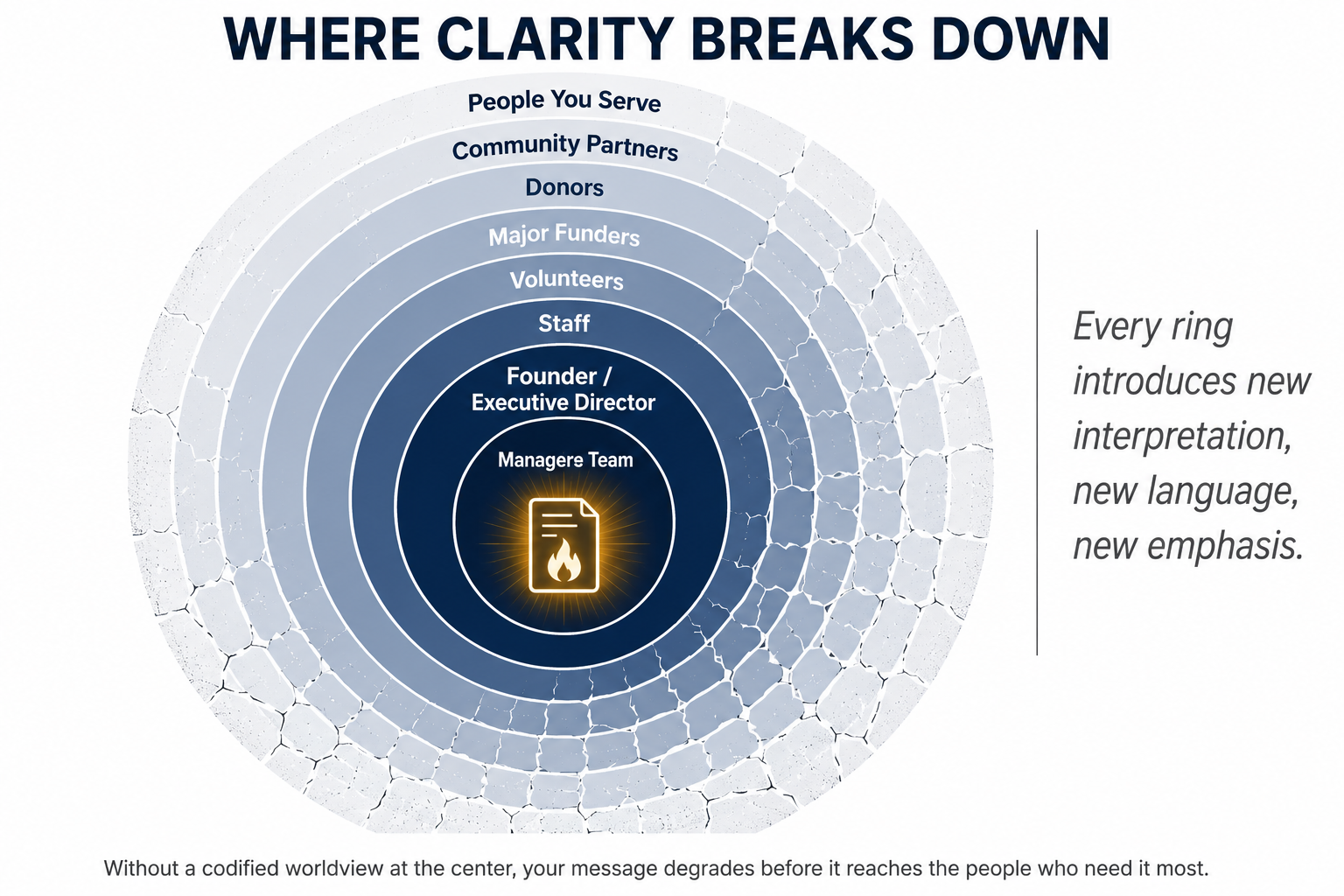
Clarity moves outward through those rings. When the worldview at the center is not codified, every ring introduces new interpretation, new language, new emphasis. By the time your message reaches your donors and the communities you serve, it has been filtered through a dozen different internal translations.
Here is what that looks like in practice.
Your major gift officer describes your work to a potential funder in terms your program director would not recognize. Your staff cannot walk a new volunteer through the logic of your approach in a coherent way. Your board members each carry a different elevator pitch. Prospects who land on your website cannot quickly figure out if you are the right organization for them.
Every one of those breakdowns traces back to the same missing center.
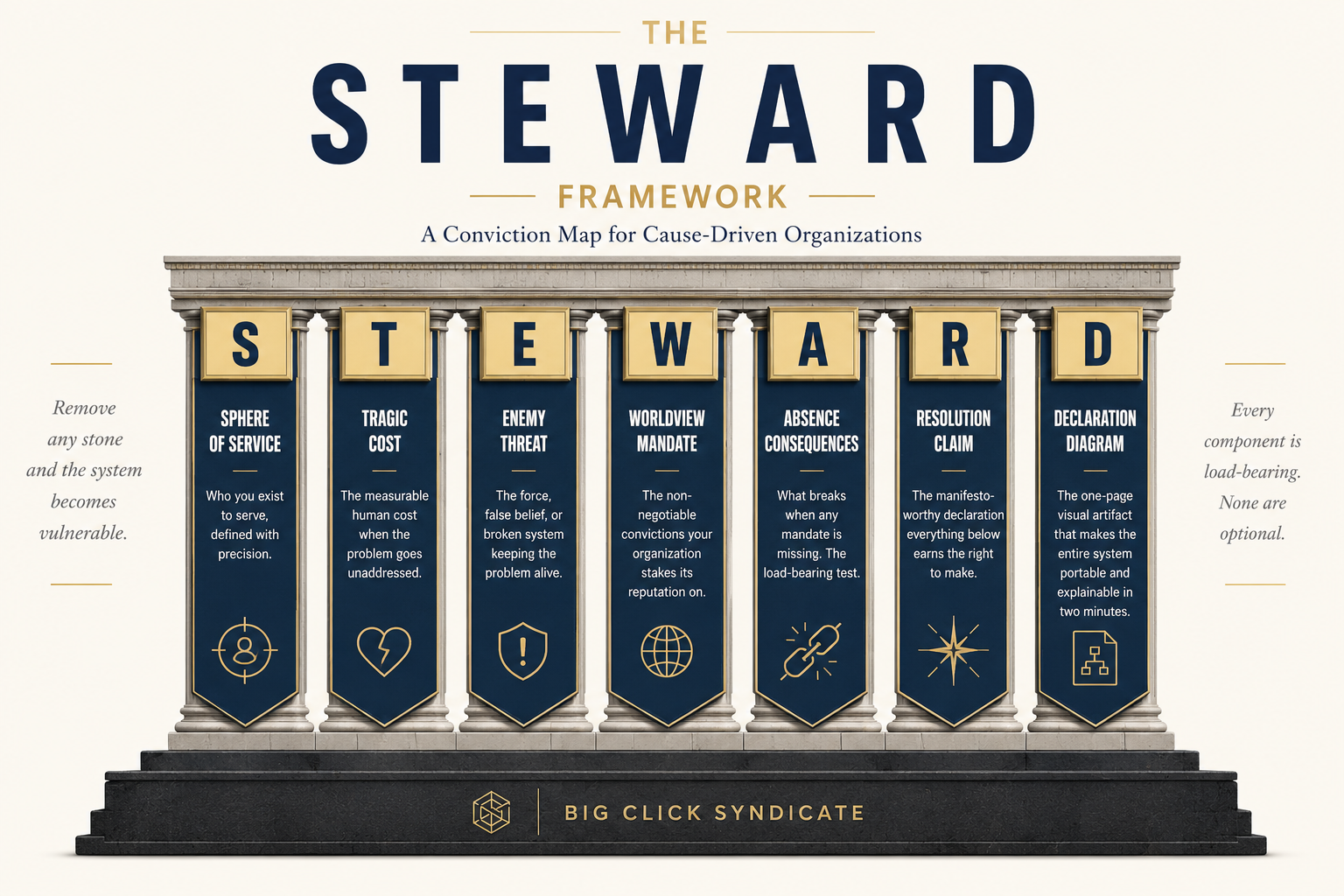
The STEWARD framework
Over years of working with nonprofits and cause-driven organizations on their marketing and positioning, I developed a structured process for building a Conviction Map. We call it the STEWARD framework. It is a seven-component system that any organization can work through, and every component is designed to be facilitated in a workshop setting with your senior leadership team.
Here is how it works.
S — Sphere of Service. Who specifically are the people your organization exists to serve? Define them with precision. Vague answers here produce vague conviction maps.
T — Tragic Cost. What is the measurable and felt human cost when this problem goes unaddressed? What are your people losing, missing, or carrying? This is the step most organizations rush past. Do not rush it.
E — Enemy Threat. What force, false belief, broken system, or cultural condition is keeping this problem alive and your people stuck? Every cause has an enemy. Naming it clearly is one of the most clarifying things a leadership team can do together.
W — Worldview Mandate. What are the three to five non-negotiable convictions your organization holds about how this problem must be solved? These are written as active declarations, not passive values. They are the beliefs you would stake your reputation on.
A — Absence Consequences. For each Worldview Mandate, what specifically breaks or becomes vulnerable when that belief is not acted on? This is the stress test. It proves each mandate is load-bearing, not decorative. A conviction map where every piece is optional is not a conviction map.
R — Resolution Claim. The single manifesto-worthy declaration that everything above earns the right to make. Written to be unforgettable. Repeatable by anyone in the organization. This is the statement that faces the world.
D — Declaration Diagram. The one-page visual artifact that makes the entire STEWARD framework explainable in under two minutes to any staff member, volunteer, donor, or partner. This is the cheat sheet your team uses in donor conversations, onboarding, partner meetings, and training. It makes the whole system portable.
What this looks like in practice
Charity: Water is one of the clearest examples of an organization operating with a fully articulated conviction map, even if they have never called it that.
Their Sphere of Service is precise: people in developing nations who lack access to clean drinking water. Their Tragic Cost is not just physical illness. It is the hours lost each day, mostly by women and girls, walking to collect dirty water instead of attending school or building a livelihood. Their Enemy Threat is not simply poverty. It is the broken systems, donor distrust, and short-term thinking that have allowed the water crisis to persist for decades despite massive amounts of aid.
Their Worldview Mandates are reflected in every operational and marketing decision they make: 100% of public donations go directly to water projects. Proof of impact is non-negotiable. Local communities must be involved in and responsible for their own water systems. Storytelling is a moral obligation.
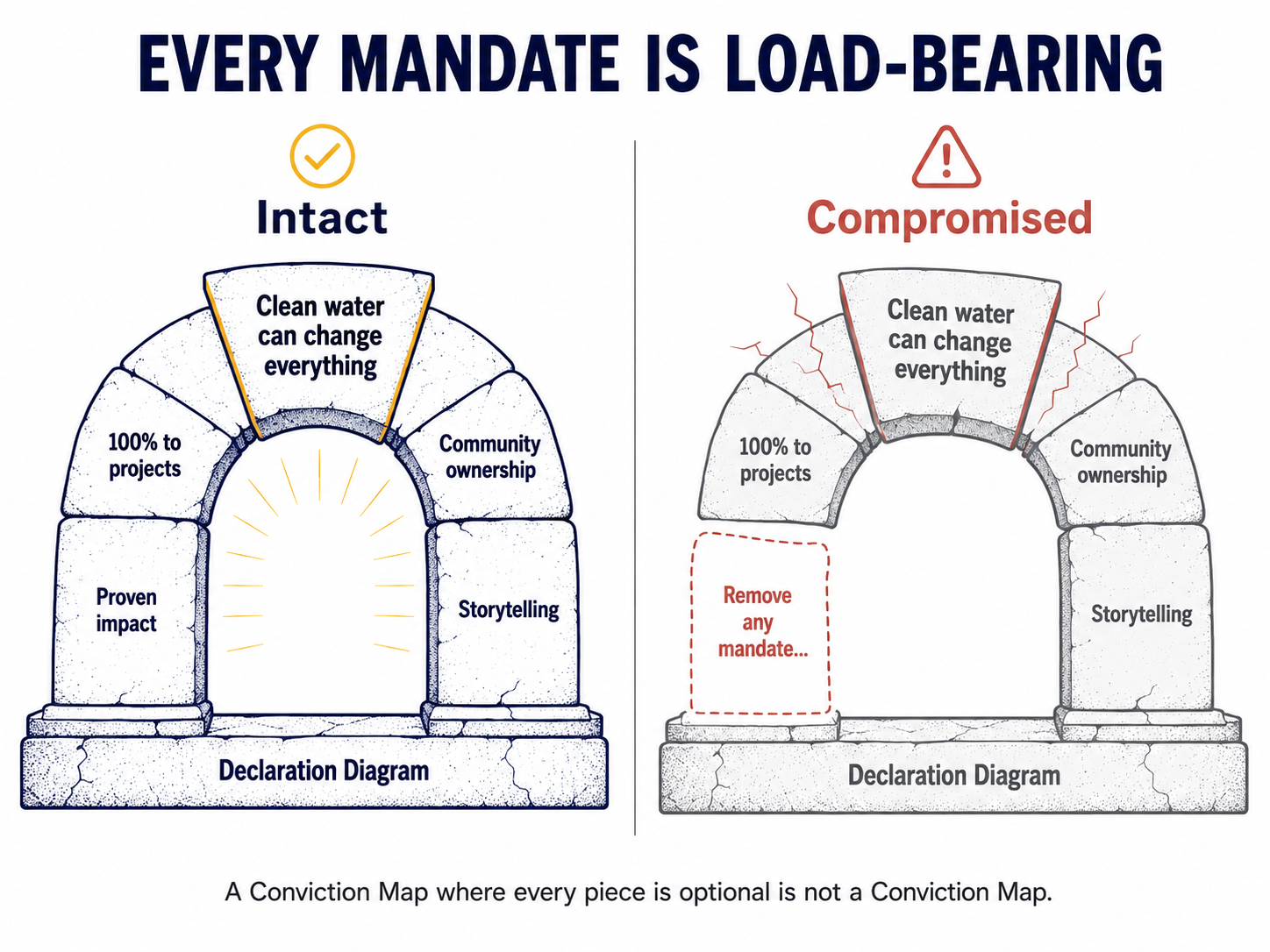
Remove any one of those mandates and the model gets vulnerable. Drop the 100% model and donor trust erodes. Remove community ownership and projects fail within years. Stop telling stories and the cause becomes invisible.
Their Resolution Claim is simple enough to fit on a wristband: clean water can change everything.
And their Declaration Diagram lives across every piece of their communications, a consistent, visual, repeatable system that any staff member or donor can explain in two minutes.
That is the difference between an organization that describes its work and one that commands authority in its space.
Why this belongs in your marketing infrastructure
The STEWARD framework is not your theory of change document. It is not your program design framework. It is not the SOP manual for how your team executes on the ground.
It is a marketing and positioning asset. It is what allows your organization to walk into any room, any funding conversation, any partnership discussion and communicate with instant clarity. It is what synchronizes every voice in your organization from the CEO to the newest volunteer so that your message does not degrade as it moves outward through those concentric circles.
It is also, in my experience, one of the most underbuilt assets in the entire cause-driven sector. Most organizations assume their leadership team is already aligned on this. Most are wrong. The twenty-minute meeting I described at the top of this article is not unusual. It is the norm.
The good news is that building a STEWARD framework is not a year-long strategic planning process. It is a focused workshop. A disciplined conversation. A commitment to pulling the worldview out of people's heads and putting it on paper where everyone can see it, pressure-test it, and use it.
The STEWARD framework is one of the core tools we use inside the A.R.T. of Engagement system to help organizations build the authority layer of their marketing infrastructure. It sits at the foundation of everything else: your messaging, your donor communications, your content strategy, your partnership conversations. Get this right and everything downstream gets cleaner and faster.
If you need help articulating your own Conviction Map that firmly establishes the Authority of your organization, let's talk!